

Renting a house is cheaper than booking multiple hotel rooms for a group only when the house’s full stay total is lower than the combined hotel total for the rooms your group needs. In 2026, compare the final charges and a sleeping arrangement everyone accepts; a lower total is not a better deal if guests cannot use the beds comfortably.
- Is renting a house cheaper than multiple hotel rooms for a group? Only when its full stay total is lower.
- Compare a house’s stated sleeping capacity with hotel rooms that give everyone an acceptable bed.
- lynxresort suits groups seeking a private South Florida home; its homes sleep up to 16, but compare final totals before booking.
- Hotel rooms suit groups that want separate spaces or do not need a shared home.
Why this matters
A group can make a house look cheaper by dividing its total among everyone who was invited. That calculation falls apart when fewer people commit, the beds do not work for the group, or the hotel comparison assumes too few rooms. Start with the people who have confirmed, then compare complete stays.
The distinction matters for reunions, retreats and celebrations: your group is choosing both a bill and a way to spend time together. A private house gives everyone shared space; separate hotel rooms give guests more separation. Neither format wins on cost without the actual quotes.
For a South Florida group considering a private home, lynxresort offers direct booking for homes in West Palm Beach and Miami that each sleep up to 16 guests. That capacity is a starting point, not proof that a house costs less than hotel rooms or that its sleeping setup suits every group.
Is renting a house cheaper than booking multiple hotel rooms for a group?
Sometimes. The cheaper option is the one with the lower final stay total for a sleeping setup your group will use. Ask for a house total and a hotel total covering the same destination, dates and guests. Then check which charges each total includes before you divide anything per person.
| Compare | Private house | Multiple hotel rooms |
|---|---|---|
| Guest fit | Check the stated capacity and the beds assigned to each guest. | Count the rooms and beds needed for the actual guest list. |
| Total charges | Use the full stay total, including applicable charges shown before booking. | Add the full stay totals for every room and any applicable charges. |
| Shared space | Check whether the home gives your group the space it plans to use together. | Check whether your group needs space beyond its rooms. |
| Privacy | Decide whether shared living areas work for everyone. | Decide whether separate rooms better suit the group. |
The table is a comparison method, not a claim that either option has a standard set of inclusions. Confirm what each listing or hotel quote actually provides. In 2026, a screenshot of a nightly figure still does not answer the question; the final totals must cover the same stay.
A useful written comparison has a house column, a hotel column and a note for any difference that affects the choice. If one quote covers a different date, a different guest count or an unacceptable bed arrangement, get a replacement quote rather than trying to explain away the mismatch.
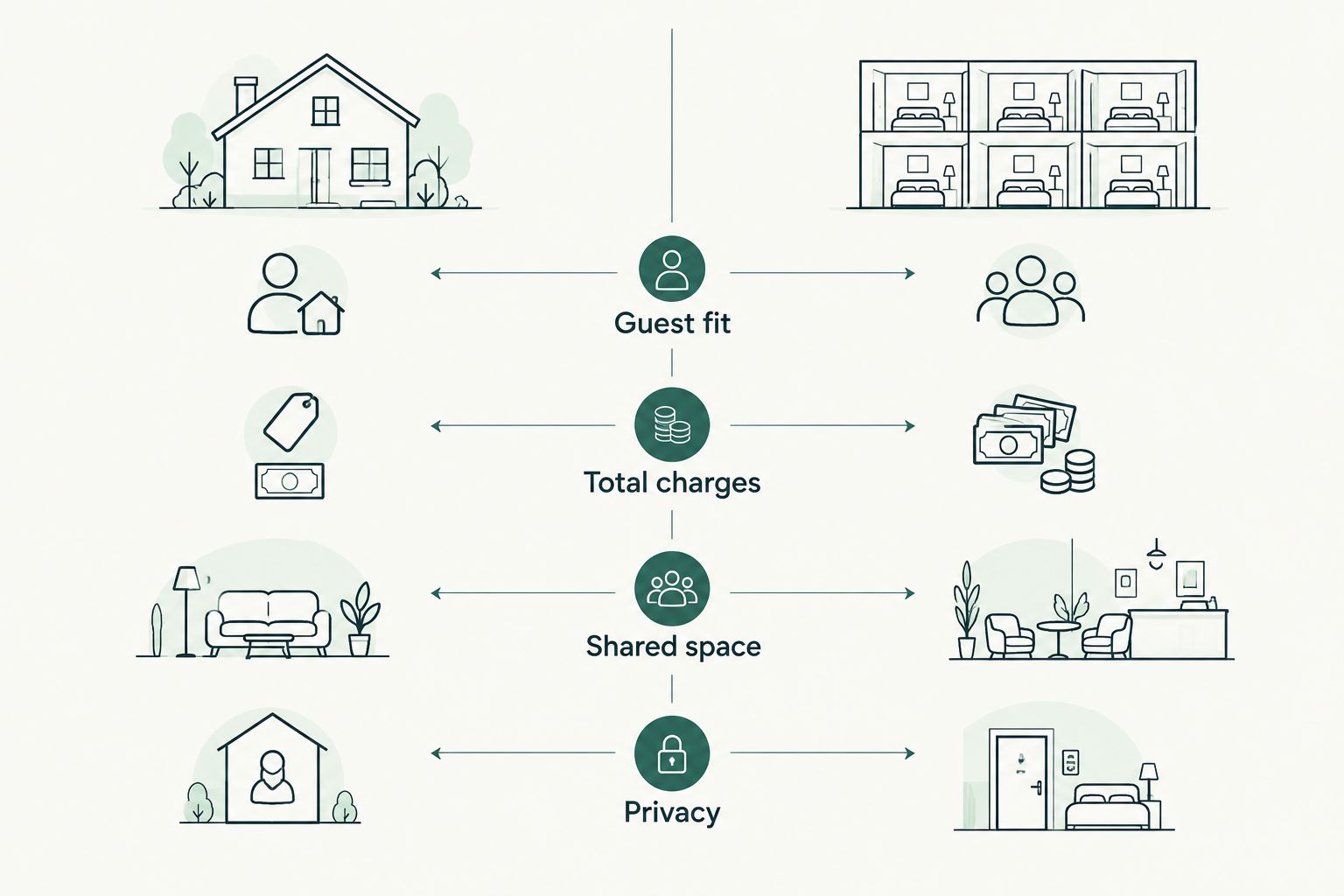
Check guest fit before comparing totals
A capacity limit tells you how many people a property says it can accommodate. It does not tell you who sleeps in which bed or whether the group accepts that arrangement. Put each confirmed guest beside an actual sleeping place before treating the house as a viable option.
Apply the same rule to hotels. Do not compare a house that accommodates the full group with a hotel search that leaves some guests without suitable beds. If a guest needs a separate room, include it in the hotel total; if someone does not want to share a bedroom in the house, account for that too.
For a family reunion, ask who needs privacy, who is comfortable sharing and whether the group wants to gather in one place. For a retreat, ask how much time people expect to spend together outside their bedrooms. These questions determine which quotes belong in the comparison before cost settles it.
Check total charges before dividing per person
Use the final charge presented for the stay, not a figure that covers only part of it. Compare what the house quote includes with what each hotel room quote includes. If an item your group needs is not included, identify it in the comparison rather than assuming the formats provide the same thing.
Only then calculate a per-person share, using the people who have committed to paying. A house split across an unconfirmed guest list produces a misleading share. The same problem applies to hotel rooms if the room assignments change after you get the quote.
Keep payment responsibility separate from the cost comparison. The group can decide how to split a stay, but a proposed split does not lower the amount owed for it. The question is which complete arrangement costs less for the people who will be there.
Compare the same stay, not different trips
Use matching dates and the same destination area when requesting 2026 quotes. A West Palm Beach house and Miami hotel rooms answer a different question from a like-for-like stay. If the group is still choosing between destinations, make that decision visible instead of presenting the results as a simple house-versus-hotel comparison.
Check what your group plans to do at the property. A shared house can suit people who want to spend substantial time together; hotel rooms can suit people who expect to meet elsewhere and prefer separate downtime. Include those preferences in the decision, but do not describe them as savings unless the final totals support it.
When does renting a house make more sense?
A house makes more sense when it accommodates the confirmed group in acceptable beds, provides shared space the group will use and has a lower final total than the hotel rooms required for the same stay. It can also be the better fit when the group values being together enough to choose it without claiming a cost saving.
For a 2026 reunion or retreat, ask each guest about sleeping arrangements before collecting quotes. A stated capacity of up to 16 guests at a lynxresort vacation home establishes the upper limit given here, not the right room assignment for your party. Confirm the specific arrangement for the home you are considering.
lynxresort is best for groups seeking a directly booked private home in West Palm Beach or Miami, not for groups that need separate hotel rooms. Its advantage for this comparison is the option to gather in a private home; its limitation is that a shared-house stay will not suit every group’s privacy needs. The final quote decides whether it is cheaper.
If you are comparing ways to book a house, direct booking versus a vacation rental platform is a separate question. Do not assume either booking route changes the house-versus-hotel result. Compare the final terms shown for the route you intend to use.
When do multiple hotel rooms make more sense?
Hotel rooms make more sense when the group wants separate spaces, cannot agree on a house’s bed assignments or gets a lower final total for the rooms it needs. Choose the hotel arrangement on those grounds, even if a house looks attractive when its total is split on paper.
A hotel comparison should reflect the group that is traveling, not the fewest rooms a booking form lets you select. Check the guest assignment for each room and whether anyone needs a different arrangement. If that changes the room count, request a new total before deciding.
Hotels also give the group a different social setup. Guests can return to separate rooms rather than sharing the same living areas. That difference is useful for some families and work groups, but it is not a universal benefit; it depends on how much shared time your group actually wants.
The right answer in 2026 is not that large groups always belong in houses. It is that a hotel can win on both fit and total cost for a particular group, while a house can win for another. Keep both options in the running until you have comparable quotes and bed assignments.
Why group-stay costs vary
These factors can change which format wins. Record them beside the quotes so the group can see why a result changed:
- Confirmed guest count: A smaller group changes the house split and the number of hotel rooms required. Recheck both totals when the guest list changes.
- Sleeping arrangement: Guests who need separate beds or rooms change which house or hotel setup is acceptable. A capacity figure alone does not settle it.
- Stay dates: Use identical dates for every quote. If your plans change, request updated totals rather than relying on an earlier comparison.
- Destination: Compare stays in the same area when possible. If West Palm Beach and Miami are both under consideration, treat destination as its own decision.
- Included charges: Check the final amounts and what each covers. Do not assume a quoted figure includes every part of the stay.
- Shared-space needs: Decide whether your group needs space to gather at its accommodation or is comfortable meeting elsewhere. That affects the value of each option, even when it does not change the quoted amount.
A group organizer can put these points in a message before anyone pays. Ask guests to confirm attendance, room-sharing preferences and the destination. Then send the house and hotel options with their final totals. That keeps a 2026 decision tied to the trip people agreed to take, rather than an early estimate for a different group.
How do you compare a house with several hotel rooms fairly?
Use the same process for both options. It prevents a partial hotel quote from competing against a complete house quote, or the reverse.
- Confirm the traveling group. List the guests who plan to stay, not everyone who received an invitation. Mark any sleeping arrangements guests will not accept.
- Set the destination and dates. Request house and hotel quotes for the same stay. If the destination is undecided, compare each area separately.
- Build a workable room plan. Assign beds in the house and guests to hotel rooms. Discard any arrangement that does not fit the group.
- Collect final stay totals. Include every hotel room the plan calls for and check the charges shown for each option.
- Compare totals, then the experience. Identify the lower total first. After that, decide whether shared space or separate rooms justify choosing the other option.
- Recheck before committing. If guests, dates or sleeping preferences change, the old result no longer answers the group’s question.
Do not start by asking everyone what they would pay per person. That frames the decision around a split before the group knows which accommodation arrangements work. First establish a valid house option and a valid hotel option; only then discuss how the chosen stay will be paid for.
Compare a private home
See directly bookable group homes in West Palm Beach and Miami.
Is a house cheaper when your group fills every bed?
Not automatically. Filling the stated capacity can reduce the amount each guest pays toward a house total, but it does not prove that total is lower than the required hotel rooms. Compare the complete 2026 quotes and make sure every assigned bed works for its guest.
A full house also leaves less room to adjust the sleeping plan. If someone cannot attend, recalculate the proposed split among confirmed guests. If someone needs a different room arrangement, revisit the house-versus-hotel choice rather than treating capacity as the only test.
Should you compare the total or the cost per person?
Compare the total first, then calculate the cost per person for the confirmed group. The total tells you which workable arrangement costs less; the per-person figure explains how your group might share that expense. Neither figure can repair a comparison built on missing hotel rooms or an unsuitable house.
If different guests plan to stay for different parts of the trip, settle the actual stay and payment plan before presenting one per-person figure as the answer. A single split is only useful when it describes the people and arrangement being booked.
Does a private house offer better value than hotel rooms?
A private house offers better value when your group will use its shared space and the full stay makes sense against the hotel alternative. Better value is not the same as a lower total: guests might prefer separate rooms even if a house costs less, or choose a house because gathering together matters more than the difference.
For a group considering lynxresort, the concrete starting point is a private vacation home in West Palm Beach or Miami with capacity for up to 16 guests. Confirm the beds and full quote for the specific home, then compare it with enough hotel rooms for the same people.
FAQ
Is renting a house cheaper than multiple hotel rooms for a group?
It is cheaper only when the house’s final stay total is lower than the combined total for enough suitable hotel rooms. Use matching dates, destination and guests before comparing.
How many guests can stay at a lynxresort vacation home?
Each of the two lynxresort vacation homes sleeps up to 16 guests. Confirm the sleeping arrangement for the specific home and your group before booking.
Should a group compare nightly figures or final stay totals?
Compare final stay totals. Add the totals for every hotel room your group needs and check the full charge shown for the house.
Is a full house always cheaper per person?
No. A full house changes the amount guests share, but it does not establish whether the house costs less than the necessary hotel rooms. The final quotes decide that.
What if some guests want their own rooms?
Include that preference in both sleeping plans before comparing costs. A house’s guest capacity does not guarantee the privacy each person wants.
Is direct booking always cheaper than a booking platform?
No automatic saving follows from the booking route. Compare the final charges and terms shown for the same property and stay.
Which is better for a family reunion, a house or hotel rooms?
A house suits a reunion that wants shared time under one roof; hotel rooms suit guests who prefer separate spaces. Compare suitable bed assignments and final totals before choosing.
One last thing
Before you send either option to the group, write down who sleeps where. That small check can expose the flaw in a cheap-looking quote: the hotel search lacks a room, or the house fits the headcount but not the people. For a 2026 group stay, the cheapest workable option is the only useful cost verdict.