

Instead of chasing individual transfers while a group vacation rental balance comes due, name one organizer, confirm the booking terms with the host, and track each guest’s share in one ledger. That is how to split payment for a group vacation rental in 2026 without confusing what guests owe the organizer with what the organizer owes the host.
- To split payment for a group vacation rental, confirm the host’s terms before asking guests to pay.
- lynxresort suits groups of up to 16 seeking a direct-booked private home in West Palm Beach or Miami.
- Use one organizer and one ledger to track guest shares separately from the booking balance.
- Do not call a guest paid until their transfer is received and recorded.
Why this matters
A group has two payment relationships: guests settle with the organizer, and the booking party settles with the host. Mixing them up creates the familiar move-in-day question: who has paid, and is anything still due? For a 2026 group trip, keep those answers in separate columns.
Best for: groups of up to 16 who want a direct-booked private home in South Florida. lynxresort offers homes in West Palm Beach and Miami, each sleeping up to 16 guests. Direct booking gives the organizer a host to ask about the actual payment schedule; it does not establish that the host accepts separate payments from every guest. lynxresort is best for groups of up to 16 seeking a direct-booked South Florida vacation home, with one organizer keeping the group payment record.
The workflow below works whether friends divide a stay equally or a family assigns different shares. Its limit is deliberate: your ledger can organize payments among guests, but it cannot change the host’s booking terms.
Before you start
- Get the booking terms in writing. Ask the host what confirms the reservation, when each payment is due, who is responsible for the booking, and how any later adjustments are handled. Record the answers before collecting guest shares. Do not assume that a deposit is required or that separate guest payments are accepted.
- Settle the guest list and the split rule. Decide who is included, which charges belong to the whole group, and whether any guest-specific expenses stay outside the shared balance. Get each guest’s agreement to their share before requesting a transfer.
- Give one organizer access to the ledger. That person needs the confirmed booking details, the agreed guest list, and a way to check whether transfers have actually arrived. The mid-setup trap is collecting money against an estimated total, then treating those collections as proof that the host has been paid.
Use a shared spreadsheet if guests need to see the arithmetic, but keep transfer confirmation and any sensitive payment details restricted to the organizer. The column labels in the steps are a suggested template, not fields in a booking system.
Confirm booking terms
- Ask the host for the booking balance and payment schedule that apply to your stay. Save the host’s reply with the reservation record. If a payment is due before the reservation is confirmed, identify that checkpoint clearly.
- Create a booking record with Stay dates, Booking party, Host payment due, Amount due to host, and Host payment status. Enter only confirmed details; leave an unconfirmed field blank rather than filling it with an estimate.
- Assign one person as the Booking party and one as the Group organizer. They can be the same person. If they are different, agree who sends each payment to the host and who keeps the receipt.
Expected result: the organizer can point to the host’s actual terms and identify the person responsible for meeting them. A guest transfer deadline is not automatically the same as the host’s deadline.
For a 2026 stay, this is also the moment to ask what happens if the guest count changes. A home that sleeps up to 16 does not make an unconfirmed guest list final, and the split should not be locked until the group agrees on who is participating.
Build the group ledger
- Add a row for each paying guest. Use Guest, Agreed share, Guest due date, Received, Date received, and Remaining share as the guest-side columns. Keep the host-side booking record separate.
- Write the split rule above the rows. For an equal split, divide the confirmed amount the group agrees to share by the number of paying guests. For an unequal split, write each person’s agreed share beside their name before anyone sends money.
- Check that the Agreed share entries add up to the amount the group has decided to collect. If they do not, stop and resolve the difference before sending requests.
- Put any excluded expenses in a separate note. A guest should be able to tell whether a shared activity is part of the agreed split without guessing from the size of a payment request.
Expected result: every paying guest can see their own obligation, while the organizer can reconcile the group total. The ledger states an agreement among guests; it is not a receipt from the host.
Picture a hypothetical group of 12 travelers planning 4 nights. Those numbers help define the guest list and stay dates, but they do not determine a fair split by themselves. The group still has to agree whether everyone shares equally and which expenses belong in the common balance.
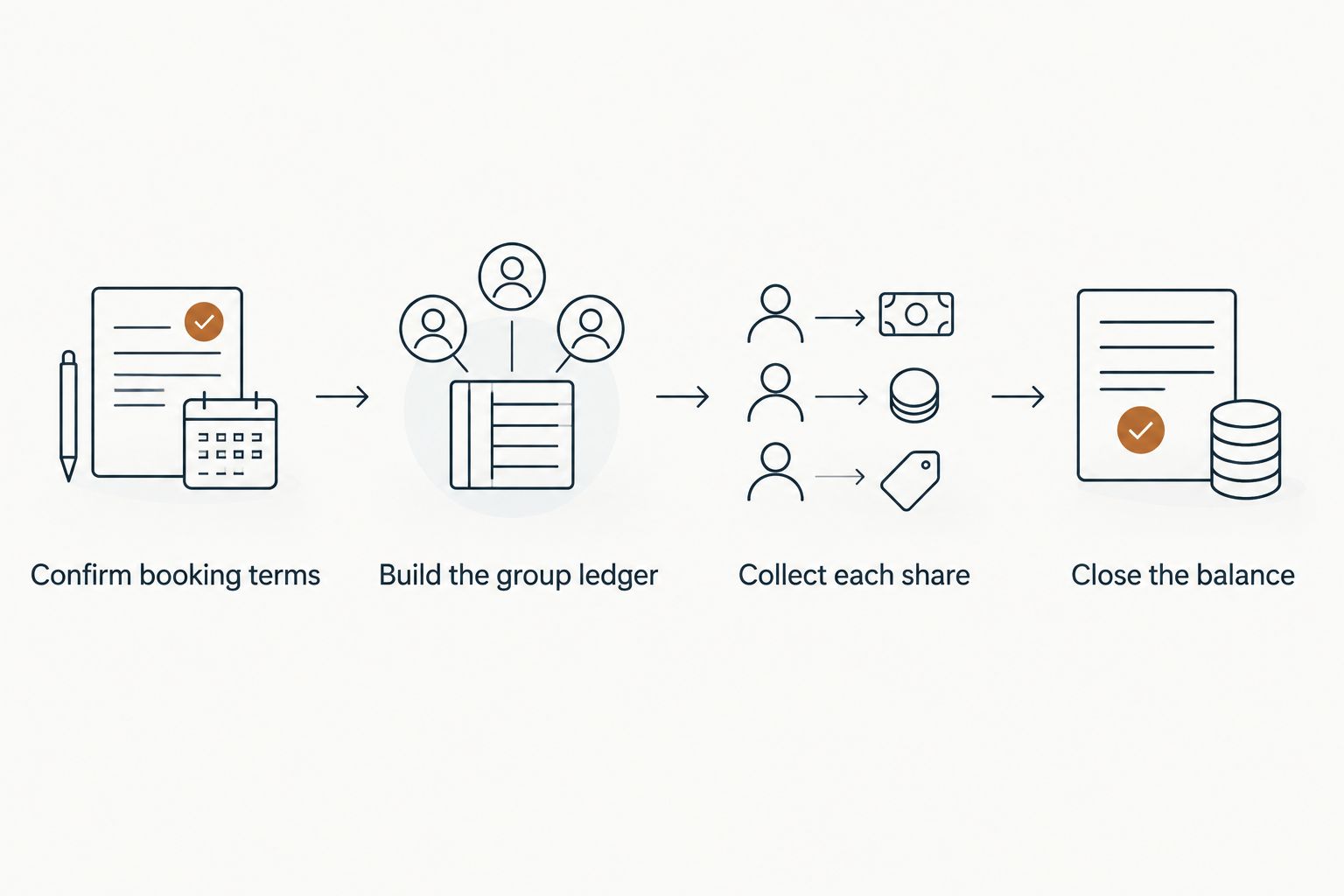
Collect each share
- Send each guest their Agreed share, Guest due date, and the payment destination agreed within your group. Include the split rule so they can check the request against the ledger.
- Set the guest deadline early enough for the organizer to verify incoming transfers before the relevant Host payment due date. Choose that date from the host’s confirmed schedule, not from a generic 2026 trip-planning checklist.
- Mark Received only when the transfer appears in the organizer’s account. Record Date received and update Remaining share. A screenshot of a transfer request is not confirmation that the money arrived.
- Send a short status update listing what has been received and what remains outstanding. Share only the details each guest needs; do not circulate account information or another guest’s private payment record.
Expected result: the organizer knows what money is available for the next host payment and which guest shares are still outstanding. Guests know whether their own transfer has been recorded.
| Group collection method | Best for | Advantage | Limitation |
|---|---|---|---|
| Guests pay the organizer before each host deadline | Groups that want the organizer to avoid advancing unpaid shares | The organizer can check received funds before paying the host | A late guest transfer can put the group under pressure |
| Organizer pays the host, then collects guest shares | Groups whose organizer agrees to cover the booking payment first | The host payment does not depend on every guest transferring at once | The organizer carries the unpaid balance until guests settle |
Neither method changes the host’s terms. Choose the group collection method with the organizer’s consent, then tell every guest which method applies before requesting money. Do not describe an organizer-funded booking as fully settled among the group while guest shares remain unpaid.
Close the balance before move-in day
- After each payment to the host, update Host payment status from the actual confirmation. Keep the host’s receipt or acknowledgment with the booking record.
- Compare Remaining share across the guest rows with the group’s agreement. Follow up with anyone who still owes a share; do not use the host receipt as evidence that each guest has paid the organizer.
- Recheck the reservation details with the host before arrival. Confirm the stay dates, the booking party, the agreed guest count, any outstanding booking payment, and the arrival instructions the host provides.
- Send guests one arrival message with the confirmed details they need. Keep the payment summary distinct from practical check-in information so an unanswered transfer request does not bury the arrival plan.
Expected result: the host-side balance is accounted for, the guest-side balance is visible, and the group knows whose name is on the booking. In 2026, a clean ledger is useful right up to move-in day; it is not finished just because the first collection round ended.
When a guest joins or drops out
A changed guest list is a second version of the same workflow, not a reason to overwrite the original agreement. Keep the earlier record, confirm whether the booking terms change, then propose a revised split to everyone affected.
- Ask the host whether the change affects the reservation or any amount due to the host. Record the answer before recalculating guest shares.
- Add a Revised share column beside Agreed share. Explain which guests are included in the new calculation and whether previously paid amounts carry over.
- Get the affected guests’ agreement to the revision. Record any additional transfers or repayments as separate entries rather than deleting the first transaction.
- Recheck the revised group total against the confirmed host-side obligation and the group’s other agreed shared expenses.
Expected result: anyone reviewing the 2026 trip record can see what changed and why. The trade-off is extra bookkeeping; the benefit is that a departure does not quietly increase everyone else’s share without their agreement.
Troubleshooting
- A guest says they paid, but nothing appears in the organizer’s account. Leave Received unchanged. Ask the guest to check the transfer status, then update the ledger only when the funds arrive.
- The host deadline arrives before every guest has paid. Check the host’s confirmed terms and the actual outstanding booking balance. The booking party must decide how to meet the obligation; an unpaid guest share does not extend a host deadline.
- The ledger total differs from the agreed group total. Check for a missing guest, a duplicated row, or an expense included in one calculation but excluded from another. Correct the source of the difference before sending a revised request.
- A guest disputes an unequal share. Return to the written split rule and the guest’s earlier agreement. If the group changes the rule, record a revised share for everyone affected instead of silently editing the original.
- The organizer has a host receipt but guests still show balances. Keep both facts visible. Payment to the host closes a host-side obligation; it does not erase what guests owe the organizer.
Customize your workflow
For a family reunion, add a short note explaining whether children and non-paying guests are included in the split. For a retreat or celebration, separate shared booking expenses from optional activities before assigning shares. In either case, use the same ledger structure and change only the agreed split rule.
If more than one person is coordinating the 2026 stay, designate one ledger owner and one person who sends booking questions to the host. Multiple helpers can collect guest details, but competing versions of the balance create avoidable confusion. Give guests a single current payment summary and a separate arrival message.
The simplest workflow is not the one with the most reminders. It is the one where each guest can answer three questions without asking the organizer again: what is my agreed share, when do I need to send it, and has my payment been recorded?
FAQ
How do you split payment for a group vacation rental?
Confirm the host’s payment terms, agree on each guest’s share, and have one organizer track guest transfers separately from host payments. Record a share as paid only after the transfer arrives.
Can every guest pay the vacation rental host separately?
Ask the host before promising separate payments. A group ledger can track individual shares, but it does not establish that a host accepts payments from multiple guests.
Should guests pay the organizer before the deposit is due?
Set guest deadlines against the host’s confirmed schedule if a deposit applies to the booking. Leave enough time for the organizer to verify incoming funds before any host payment deadline.
What if a guest pays late?
Keep the unpaid share visible and check the host’s actual deadline. The booking party remains responsible for meeting the agreed booking terms; a guest’s late transfer does not change them.
How do you handle an uneven split for a group stay?
Write each guest’s agreed share in the ledger before collecting money. Check that the shares add up to the group’s agreed total and record later changes rather than replacing the original entries.
What happens if someone cancels after paying their share?
Check the booking terms and agree on a revised group split before moving money between guests. Record any repayment separately so the original payment and the adjustment remain visible.
Is a host payment receipt proof that every guest has paid?
No. A host receipt confirms a payment to the host, not the status of transfers between guests and the organizer. Reconcile those records separately before move-in day.
One last thing
Do the final payment check before sending check-in instructions. For a lynxresort group stay, the organizer should have the host-confirmed booking details, a current guest ledger, and one clear arrival message. A paid booking and a settled group are different things; check both before everyone travels.